Social distancing is here to stay, Levine says
MONTPELIER- Get used to social distancing and wearing masks, even as the state opens the "spigot" to get more Vermonters back to work.
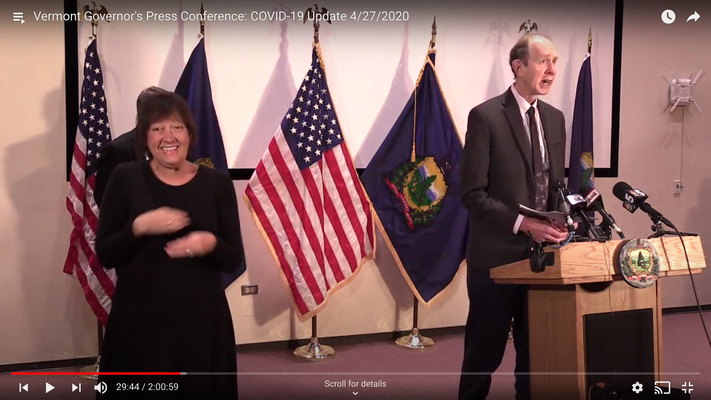
"Social distancing is here to stay," said Vermont Health Commissioner Dr. Mark Levine at Monday's Statehouse press conference. "Expect it to be part of the Vermont scene even as we reopen Vermont."
Levine said he prefers the term "physical distancing" instead. "Social distancing implies a lack of social connectivity," he said, "and as we've discussed a variety of health-related items over the last few years, one of the things that ties them together is social isolation. The last thing we want to create is social isolation. So if we can remain cognizant of physical distancing while staying socially connected, I think that would be far healthier for us all."
Levine also said that Vermonters will be asked to wear face masks, at least until there are anti-viral treatments or a vaccine for COVID-19. "Facial covering is here for the time being as well," he said. "One of the prime reasons Vermonters send me letters and emails is to complain, not about this, but when they see others without facial coverings. I conducted my own weekend survey once again, and went to the supermarket. I'm happy to announce that every employee was wearing a facial covering and adhering to this rule, and they understood why, as well. Regarding the customers, it was in the 80% to 85% range. So, clearly a majority, but we can do better and we really must do better to protect one another because we're all in this together."
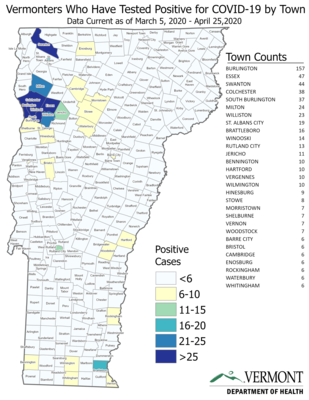
Reporter Mike Donoghue, of The Islander, said a map of COVID-19 cases released Monday had "serious flaws" and would likely be "disappointing" to Vermonters. In particular, he noted the map indicates there are 44 positive cases in Swanton, while nearby St. Albans Town, where 38 prison inmates were diagnosed with COVID-19, is listed as having less than six cases. The map also lists a number-range of cases in most Vermont towns, rather than an exact number. In Dover, for instance, the map indicates a range of zero to five cases, making it unclear whether there are zero cases or five. The color code for nearby Wilmington and Whitingham indicates six to 10 cases. A list accompanying the map, however, indicates Whitingham has 7 cases and Wilmington has 10 cases reported, however, the exact totals for only 29 towns are on the list. Donoghue said Grand Isle County has had three COVID-19 cases, all in one town, but the map doesn't indicate that there is a "pocket" of COVID-19 infection in that town. He asked why the administration doesn't release the exact total number of cases in all 250 towns.
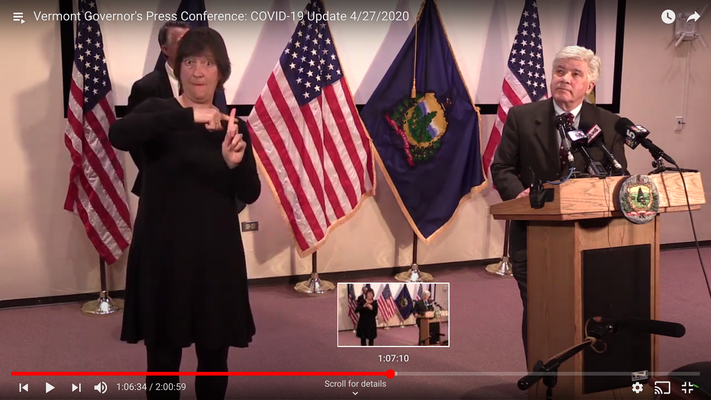
Agency of Human Services Secretary Michael Smith said the state could look at how the numbers are reported. But he said the agency of human services and the Vermont Department of Health had been careful not to release information that could identify patients. "We don't want to put a scarlet letter on people as we're looking at this virus," he said. "And I've seen some indications of that along the way, for example, people have suggested if we're having a surge site, it should be fenced off. It's not a prison. These are for people to go to a site in order to recover if they don't want to be around their families or they don't have a home to go to. There was a mention in one of the newspapers that these people should be wearing special uniforms or special markers on them. We're not going to do that in this state. So we try to strike a balance between identifying how many are in a town, and where it would be identifiable in a town, trying to say there's zero to five in that town." Smith said the health department would be willing to look at any discrepancies in the map. Donoghue suggested the state look at Connecticut's COVID-19 map, which lists deaths and actual numbers town by town.
Levine responded to a question asking whether a higher incidence of COVID-19 in ski towns including Stowe, Woodstock, and Wilmington indicated "out-of-staters" may have brought COVID-19 to those areas. "We're quite aware that out-of-state people have come to Vermont and have been diagnosed shortly after arriving," Levine said. "That's the reality of a virus that knows no borders. What the percentage of cases is, it's hard to tell. Likewise with Vermonters who flew home from Spain, Italy, and other parts of Europe and brought the virus with them. They still get tallied up the same way, and we don't think any less of them because they got the virus in their travels. It's part of how the virus became entrenched in this country."
The map can be found at https://www.healthvermont.gov/response/coronavirus-covid-19/current-acti....
Department of Economic Development Commissioner Joan Goldstein announced that the Small Business Administration had re-opened the window for businesses to apply for loans under the Paycheck Protection Program. The program, initially funded with $350 billion in the CARES Act, provides loans to businesses "to bring people back to work or prevent them from being laid off in the first place," Goldstein said. "Part of those funds will be forgiven if they are used for payroll." The initial funding ran out in just 13 days, but the program has been revived with a new round of funding. "The new bill signed on Friday allocates over $300 billion to this program, and we're expecting this to be deployed with even more speed," Goldstein said. "If you have already applied, make sure your lender has communicated that you're already in the queue. If they haven't, make sure you contact them, this is on a first come, first served basis."
Goldstein also noted that the state is still waiting for federal guidance on which expenses are "forgivable" under the PPP. "I urge you to get proper guidance and advice from your accountants and other technical advisers."